
Guide for seniors
Elders at the Threshold
Psychedelics for Seniors
A practical guide to the science, safety, and promise of psychedelic medicine in later life.
Get it on Amazon ↗
Jim Tate · Writer & host
Essays, books, and conversations on the history, policy, chemistry, and people shaping the psychedelic revival, written with an eye for evidence and for the stories history left out.

On Substack
The legacy, culture, and potential impact of psychedelic substances: history, policy, chemistry, and the people shaping the movement.
Read on Substack ↗Loading recent essays…
No paywall. New essays arrive by email as soon as they are published.
In-depth reads
Longer works on psychedelic medicine, culture, safety, and practice.
Guide for seniors
Psychedelics for Seniors
A practical guide to the science, safety, and promise of psychedelic medicine in later life.
Get it on Amazon ↗
The Chronicles of Kykeon series
Hiding in Plain Sight, the World's Most Potent Natural Psychedelic
A concise introduction to salvia divinorum and a new entry in The Chronicles of Kykeon series.
Get it on Amazon ↗Watch & explore
Books, films, and ideas from across the psychedelic landscape, in conversation with the people who made them.

Books & ideas
Conversations with the authors of books from across the psychedelic landscape.
Loading recent videos…

Film & media
Psychedelic stories and ideas through film and media, with the filmmakers behind them.
Loading recent videos…
In my office I have what I call “my psychedelic bookshelf.” Books come and go, but some remain for years. Here are the titles on that shelf today.
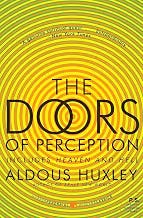
In May 1953, Huxley took mescaline at his Los Angeles home with psychiatrist Humphry Osmond present, then wrote this short account. It gave a generation its vocabulary for the experience. Read it as one gifted writer’s single afternoon, not as evidence of anything general.
Buy on Amazon ↗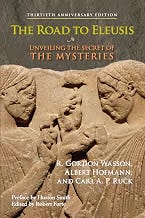
The book that proposed that the kykeon of the Eleusinian Mysteries contained ergot alkaloids. It is why I write under the banner of Chronicles of Kykeon. It remains a hypothesis. No chemical evidence from Eleusis itself has confirmed it, and readers should treat later popular books that build on it with the same caution.
Buy on Amazon ↗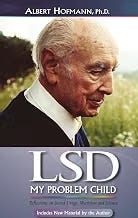
The Sandoz chemist’s own account of synthesizing LSD in 1938 and discovering its effects in 1943. It is measured, sometimes rueful, and more honest about risk than many books written by his admirers. The title says it all.
Buy on Amazon ↗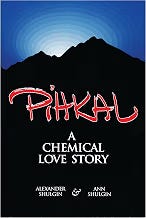
Half memoir, half lab manual. The second half documents phenethylamine compounds Sasha Shulgin synthesized and tested. The first half is a love story, and Ann Shulgin’s voice in it is too often skipped. The dosing notes are self-experiments, not clinical data.
Buy on Amazon ↗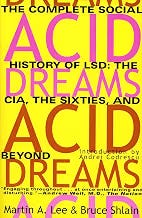
A history of LSD built heavily on declassified documents, including the CIA’s MKUltra program. It showed that the government’s interest in these drugs was older and darker than the counterculture story suggests. Some of its interpretations are contested, but the documents are real.
Buy on Amazon ↗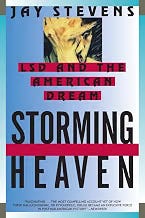
The best single narrative of how LSD moved from psychiatric wards to Harvard to Haight-Ashbury to prohibition. Stevens is a storyteller, and the book reads that way. Pair it with Acid Dreams for the parts he leaves in shadow.
Buy on Amazon ↗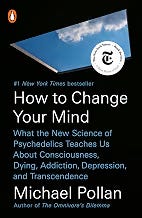
The book that carried the clinical revival to a mainstream audience. Pollan is a careful reporter, and he is candid about his own skepticism. But many of the trials he describes were small. Larger studies since, such as a 233-person psilocybin trial for treatment-resistant depression published in 2022, have found real but more modest effects. Read it as a starting point, not a verdict.
Buy on Amazon ↗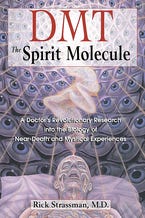
Between 1990 and 1995, Strassman ran the first new government-approved human psychedelic research in the United States in about twenty years, giving DMT to volunteers at the University of New Mexico. This book is his account of that work. The clinical chapters are careful. His speculation that the pineal gland releases DMT at birth and death remains unproven in humans, and readers should keep the two apart. I talked with Strassman about the book on The Psychedelic Bookshelf.
Buy on Amazon ↗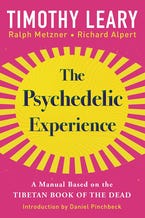
Written by three Harvard psychologists shortly after Harvard dismissed Leary and Alpert, this guide recasts the Tibetan Book of the Dead as a map for an LSD session. It is where many readers first met the idea that set and setting shape the trip. It is also a free Western adaptation of a Buddhist funeral text, written by men with a mission, and it offers no clinical evidence for its claims.
Buy on Amazon ↗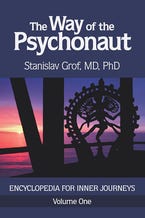
Grof began giving LSD to patients in Prague in the 1950s and supervised thousands of sessions over the following decades. This two-volume work, published by MAPS, gathers a lifetime of his clinical observation and theory. His map of birth-related “perinatal” experiences is influential but has never been tested in controlled research. Holotropic Breathwork, the drug-free method he describes, was developed with his wife, Christina Grof, whose part is usually reduced to a footnote.
Buy on Amazon ↗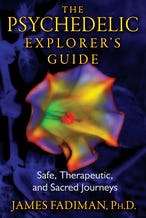
Fadiman took part in psychedelic research in the early 1960s and kept the subject alive through the long quiet decades. The book is a practical guide for guides and sitters, with a careful emphasis on preparation and safety. Its chapter on taking very small doses helped launch the microdosing movement. A large placebo-controlled study published in 2021 found that microdosers improved about as much as people unknowingly taking placebo, so treat that chapter as a hypothesis, not a result.
Buy on Amazon ↗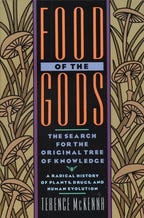
McKenna’s sweeping argument that plants and psychoactive drugs shaped human history and even human evolution. It made him the field’s most quoted speaker for a generation. Its best-known claim, that early humans eating psilocybin mushrooms drove the growth of the human mind, has no supporting evidence in the fossil or archaeological record. Read it as a brilliant talker’s provocation, not as history.
Buy on Amazon ↗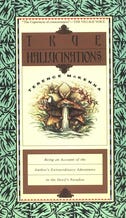
McKenna’s memoir of the 1971 trip he took with his brother Dennis and a few friends to La Chorrera in the Colombian Amazon, where the brothers set out to fuse mushroom chemistry with their own minds. It is vivid and funny, and it built the McKenna legend. Dennis later told the same story in his own memoir and was far franker that what happened to him there looked a lot like a psychotic break. Read the two side by side.
Buy on Amazon ↗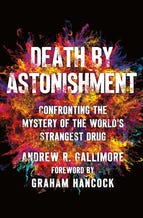
A pharmacologist’s history of DMT, from Amazonian snuffs and the botanist Richard Evans Schultes through Burroughs, Leary, McKenna, and Strassman to current attempts to hold people in the DMT state for longer periods. Gallimore knows the chemistry, and the history is well told. He is also openly drawn to the idea that DMT gives access to a real, independent world. That is a philosophical position, not a scientific result.
Buy on Amazon ↗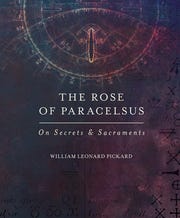
Pickard was arrested in 2000 after federal agents raided a decommissioned missile silo in Kansas, and in 2003 he received two life sentences for what the DEA called the largest LSD manufacturing operation in American history. He wrote this book behind bars, and it was published while he was still serving his sentence. Part memoir, part philosophical journey through the psychedelic underground, it circles questions of secrecy, loyalty, and betrayal. He was granted compassionate release in 2020. No other book gives the view from inside the prohibition era the way this one does.
Buy on Amazon ↗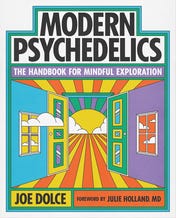
A handbook, not a memoir. Dolce works through the major substances one by one, from psilocybin and MDMA to ketamine, ayahuasca, and ibogaine, and sets them inside the longer history of ceremonial use, prohibition, and the clinical revival. What sets it apart is how much attention it gives to who should not take these drugs, the risks of unscreened underground providers, and the hype that commercialization has brought. It is the book I wish had existed twenty years ago. I talked with Dolce about the book on Inside the Revival.
Buy on Amazon ↗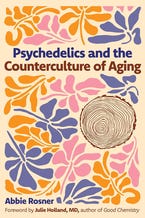
Rosner has been writing about older adults’ use of cannabis and psychedelics since 2018, and this book puts a generation the field usually ignores at the center. At its heart are firsthand accounts from more than thirty older users about grief, intimacy, spiritual change, and coming to terms with death, alongside a review of the research and of how older people are getting access, legally and otherwise. This is the book that makes the case that elders belong in the conversation.
Buy on Amazon ↗
Lattin, a longtime religion reporter for the San Francisco Chronicle, follows four men whose paths crossed at Harvard in the early 1960s: Timothy Leary, Richard Alpert (later Ram Dass), the religion scholar Huston Smith, and Andrew Weil, then an undergraduate who helped bring the psilocybin project’s troubles into the open. Each went on to shape a different strand of American life, from the counterculture and Eastern spirituality to the study of world religions and integrative medicine. It is a lively group biography, frank about the rivalries and egos, rather than a history of the research itself. I talked with Lattin about the book on The Psychedelic Bookshelf.
Buy on Amazon ↗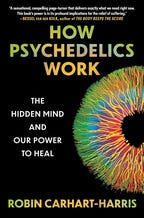
Carhart-Harris led the psychedelic research center at Imperial College London before moving to UC San Francisco, and his brain-imaging work is behind much of today’s talk of psychedelics “loosening” a rigid mind. This is his account for general readers, arguing that much mental illness is a form of mental rigidity that psychedelics can temporarily relax. The book is not out until February 2027, but I just read a galley copy. This may well be the most important book on psychedelics in 2027.
Pre-order on Amazon ↗As an Amazon Associate I earn from qualifying purchases.

About
Jim Tate is a writer, researcher, and podcast host with some thirty years in healthcare, health information technology, and regulatory compliance. He brings that background to nuanced, evidence-aware work at the intersection of healthcare, policy, and psychedelic science.
He writes Chronicles of Kykeon on Substack, hosts The Psychedelic Bookshelf and The Psychedelic Silver Screen, and is the author of Elders at the Threshold and The Little Book of Salvia Divinorum.
Kykeon was the ceremonial drink of the Eleusinian Mysteries. Taking its name is a declaration of intent: to look at these substances with the seriousness the ancients gave them.
Say hello
Questions, comments, or a guest you think should be featured? Jim would love to hear from you.
Email Jim ↗